
How Much Does It Cost to Outsource Call Handling in the UK?
If your business is missing customer calls, hiring a full-time receptionist is not your only option. Outsourcing your telephone answering can help you respond to more enquiries, manage busy periods and provide support outside normal working hours.
The price depends on how many calls your business receives, how long conversations last, the hours you need covered and whether you require simple message-taking or more involved customer support. For a small business, a basic answering package may cost tens of pounds per month, while higher-volume services, dedicated agents and extensive out-of-hours coverage can cost several hundred pounds per month or more.
The most cost-effective option is not necessarily the one with the lowest advertised monthly fee. It is the service that answers the calls you would otherwise miss, handles them correctly and helps you win or retain business without creating unnecessary costs.
Indicative UK Price Guide
Basic message-taking£25–£75 / month
Part-time or overflow answering£50–£200 / month
Virtual receptionist service£75–£300+ / month
Extended or out-of-hours£100–£400+ / month
Higher-volume call handling£300–£1,000+ / month
Broad budgeting guidance, not a guaranteed quotation.
Get a Call Handling Quote for Your Business
Smart Call Solutions can help you explore call handling options around your business hours, call volume and customer requirements.
In This Guide
Everything to check before you compare outsourced call handling prices.
How Much Does Outsourced Call Handling Cost in the UK?
The following table provides indicative budgeting ranges to help you understand what different levels of telephone support might involve. These are illustrative estimates, not Smart Call Solutions' published tariffs.
| Type of call handling | Indicative monthly budget | Suitable for |
|---|---|---|
| Basic message-taking | £25–£75 | Sole traders and businesses with occasional calls |
| Part-time or overflow call answering | £50–£200 | Small businesses experiencing missed calls during busy periods |
| Virtual receptionist service | £75–£300+ | Businesses needing call screening, transfers and appointment enquiries |
| Extended-hours or out-of-hours answering | £100–£400+ | Businesses receiving enquiries in the evenings or at weekends |
| Higher-volume outsourced call handling | £300–£1,000+ | Growing businesses with more frequent or complex calls |
| Dedicated or specialist agent support | Individually quoted | Businesses requiring tailored workflows, training or substantial coverage |
Actual prices can fall outside these ranges. Some providers charge per answered call or per minute, while others offer monthly packages or bespoke quotations. Check the provider's current tariff, VAT treatment, included allowance and service scope before budgeting.
Published UK provider prices vary considerably by service and billing model, so these figures should be treated as broad budgeting guidance rather than a guaranteed quotation.
The most cost-effective option is not necessarily the one with the lowest advertised monthly fee. It is the service that answers the calls you would otherwise miss and helps you win or retain business.
What Affects the Monthly Price?
Your outsourced call handling costs will generally depend on six factors. For an accurate estimate, start with your actual call pattern rather than choosing a package based only on its headline price.
1
Call volume
The number of calls answered each month determines whether a small package or a larger service is more suitable.
2
Average call duration
Longer conversations can increase costs when a provider charges by the minute.
3
Coverage hours
Evening, overnight, weekend and bank holiday requirements may affect the price.
4
Call complexity
Taking a message is different from qualifying a sales enquiry, arranging an appointment or transferring a call to the correct department.
5
Agent requirements
Specialised training, detailed scripts and industry-specific procedures may require additional preparation.
6
Systems and reporting
CRM integration, booking systems, call reports and bespoke workflows can affect the overall quotation.
Comparing Providers?
Read our practical guide to choosing an inbound call centre in the UK.
What Is the Cheapest Way to Outsource Business Calls?
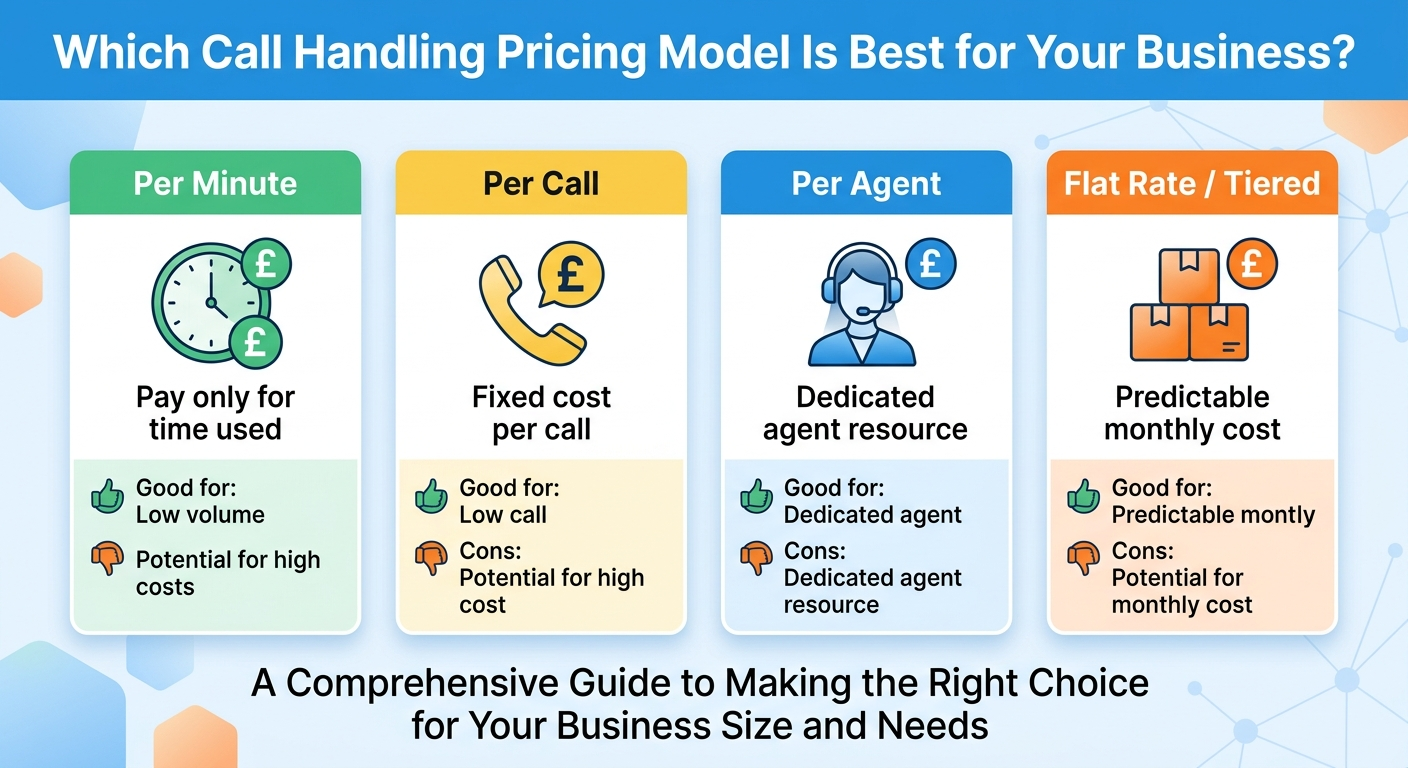
The cheapest option depends on what happens when someone calls your business and nobody is available to answer.
1. Pay-per-call answering
With a pay-per-call service, you are charged for each call handled. This can suit businesses with low or unpredictable call volumes because you may not need a substantial monthly commitment.
However, the total can increase quickly if your business receives more calls than expected. Check whether unsuccessful transfers, wrong numbers, sales enquiries and short calls are chargeable.
2. Monthly call answering packages
A monthly package normally includes a set allowance of calls, minutes or services. It can make budgeting easier when your call volume is reasonably predictable.
Before signing up, ask what happens when you exceed the allowance. Additional call charges can make a seemingly inexpensive package less attractive during busy months.
3. Outsourced overflow call handling
If you already have someone answering your main business line, you may not need to outsource every call.
Overflow call handling provides additional support when your team is busy, unavailable or dealing with several callers at once, without paying for unnecessary full-time coverage.
4. Out-of-hours call answering
If most of your calls arrive outside normal working hours, an out-of-hours service may be more appropriate than a full daytime package.
Agents can take messages, record important details, transfer urgent calls or follow an escalation process. Confirm which activities are included and whether overnight, weekend and holiday coverage carries additional charges.
5. Dedicated outsourced agents
Businesses with high call volumes or more involved customer requirements may benefit from a dedicated team or a tailored outsourced customer service arrangement.
This option can offer greater consistency and familiarity with your business, but the price will depend on staffing requirements, coverage, training and workload.
A useful rule: choose the smallest service that reliably covers your actual need, while allowing enough flexibility for peak periods and business growth.
Outsourced Call Handling vs Hiring an In-House Receptionist
If you are deciding between an answering service and employing someone, compare the complete cost of each option rather than salary against a monthly service fee.
| Cost or consideration | In-house receptionist | Outsourced call handling |
|---|---|---|
| Staffing cost | Salary and employer costs | Agreed service fee and usage charges |
| Recruitment | Recruitment and onboarding may be required | Provider manages its agents |
| Holiday and sickness cover | Cover arrangements may be needed | Depends on the provider's service agreement |
| Busy periods | Limited by available staff and phone capacity | Additional handling may be available |
| After-hours coverage | Usually requires extra staffing arrangements | Can be arranged according to the package |
| Business knowledge | Builds familiarity through direct employment | Depends on training, scripts and continuity |
| Management | Internal supervision and scheduling | Provider management, with your oversight of service quality |
| Flexibility | Changes may require staffing adjustments | Some packages can be adjusted as demand changes |
Outsourcing does not automatically cost less in every situation. A business with continuous, high-volume calls and substantial internal responsibilities may benefit from an in-house team. A smaller business that needs reliable call coverage without employing a receptionist may find outsourcing more practical.
The right comparison should include the hours of coverage, number of calls handled, service quality, additional charges and the time your own staff spend managing enquiries.
Customers Calling After Hours?
Find out more about after-hours answering for your business.
How to Calculate Your Outsourced Call Handling Budget
You can estimate your likely monthly spend with a few straightforward figures.
Step 1: Estimate the calls you need answered
Count the calls your business receives during the hours you want to outsource. Use a representative period, including busy days and quieter periods.
Step 2: Estimate average call duration
If the provider charges by the minute, calculate the approximate total talk time. For example, 300 calls per month averaging three minutes each represent approximately 900 minutes of call handling.
Step 3: Check the billing model
Find out whether your provider charges per call, per minute, per package or through a tailored monthly agreement.
Step 4: Add extra charges
Include setup costs, additional minutes, out-of-hours coverage, integration fees and any minimum monthly commitment.
Step 5: Compare the total with the value of the calls
Consider whether answered calls result in appointments, bookings, quotations, sales or better customer retention.
Worked Example: Estimating the Value of Answered Calls
Suppose your business receives 300 calls per month and currently misses 30 of them. You estimate that 20% of those missed callers would have become customers if they had received a suitable response.
That represents six potential customers per month. If the average value of a new customer is £150, the potential revenue associated with those six customers is:
6 customers × £150 = £900 in potential revenue.
This is a planning example, not a promise of additional revenue. Not every missed call represents a genuine sales opportunity, and not every answered enquiry converts. Your actual results will depend on lead quality, agent performance, prices, availability and follow-up.
Why this calculation helps
- It shows what an answering service needs to deliver to justify its cost.
- It turns a monthly fee into a comparison with real business value.
- It highlights which missed calls are genuine enquiries.
- It gives you a better basis than comparing headline prices alone.
Start with your own call figures, then request a quote.
Which Businesses Benefit Most from Outsourced Call Handling?
Outsourcing can be useful when customers need a reliable response but your staff cannot always answer the phone.
Small businesses and sole traders
If you spend your working day delivering a service, visiting customers or completing jobs, answering every call may be difficult. An answering service can capture enquiries while you concentrate on your work.
Trades and emergency services
Plumbers, electricians, maintenance companies and other service businesses may receive urgent enquiries while their teams are on site. Agreed call-handling procedures can help identify urgent requests and direct them appropriately.
Taxi and transport companies
Taxi operators and private-hire businesses may need help with bookings, changes, cancellations, fare enquiries and overflow calls during busy periods. Agents need clear procedures for collecting journey details and passing bookings into the appropriate system.
Estate agents and property management
Property enquiries, viewing requests, maintenance reports and tenant calls can arrive while staff are meeting customers or visiting properties. Structured call handling helps ensure that messages reach the right person.
Clinics and appointment-based businesses
Businesses that rely on appointments can benefit from consistent enquiry handling and booking support. Where sensitive information is involved, the service must follow appropriate confidentiality, data-protection and escalation procedures.
Growing businesses and customer support teams
When internal staff cannot keep up with incoming enquiries, outsourced agents can provide additional capacity without requiring the business to recruit immediately.
The most suitable service depends on your callers, operating hours, call complexity and the consequences of a missed call.
Want to Check Service Quality?
Explore quality assurance support in the UK.
How to Choose the Right UK Call Handling Provider
Price matters, but it should not be the only factor in your decision. Use these questions when comparing outsourced telephone answering services.
- Can the provider cover the exact hours your business requires?
- Are calls answered by trained human agents, automated systems or a combination?
- Can agents use your preferred greeting, scripts and escalation instructions?
- Can they transfer calls, take messages and arrange appointments where required?
- How are urgent enquiries identified and escalated?
- Are calls handled under appropriate confidentiality and data-protection arrangements?
- Can the service scale when call volumes increase?
- What reporting is available for answered calls, missed calls, messages and outcomes?
- What is the complete monthly cost, including excess usage and additional services?
- Can you test the service before committing to a longer agreement?
A provider should be able to explain what happens from the moment a customer calls until the enquiry reaches the right person.
Outsource Your Business Calls with Smart Call Solutions
If missed calls are costing your business time, opportunities or customer confidence, Smart Call Solutions can help you explore a more practical approach to telephone support.
We provide call-handling solutions designed around business requirements, including support for incoming enquiries, message-taking, call transfers, appointment handling and overflow requirements. The appropriate arrangement depends on your agreed workflow and service needs.
Rather than choosing a package based on a headline price, start by identifying when calls are missed, what callers need and how each enquiry should be handled.
When you contact us, tell us:
- How many calls your business receives on a typical day or month.
- Whether you need weekday, evening, overnight or weekend cover.
- Whether agents need to take messages, transfer calls, arrange appointments or follow specific instructions.
- Which calls require urgent escalation.
- Whether your existing team needs occasional overflow support or more regular assistance.
Want to Explore the Right Call-Handling Solution?
With these details, you can discuss an arrangement that matches your operational requirements and obtain a quotation based on the service you actually need.
Contact Smart Call Solutions to discuss your requirements and request a tailored quotation.
You can also ask about a free one-week trial, subject to the current offer and agreed eligibility, before deciding whether the service suits your business.
Contact Smart Call Solutions
Websitesmartcallsolutions.net
Telephone+44 20 8050 0285
Emailinfo@smartcallsolutions.net
Frequently Asked Questions
How much does it cost to outsource call handling in the UK?
The cost depends on call volume, average call duration, coverage hours and the level of support required. Basic answering packages may cost tens of pounds per month, while higher-volume, extended-hours or tailored services can cost several hundred pounds or more. Request a quotation based on your actual requirements.
Is outsourcing call handling cheaper than hiring a receptionist?
It can be, particularly if you only need part-time coverage, overflow support or out-of-hours answering. However, the result depends on call volume, the complexity of enquiries and the total cost of the outsourced service compared with employing and managing staff.
What is included in a telephone answering service?
Depending on the package, services may include answering calls in your business name, taking messages, screening enquiries, transferring calls, booking appointments and following agreed escalation instructions. Always confirm the exact inclusions before signing up.
Can a small business outsource calls without a long-term contract?
Some providers offer flexible or pay-as-you-go arrangements, while others require monthly commitments or fixed-term contracts. Ask about minimum spend, cancellation periods and any setup charges before choosing a provider.
Is 24/7 call handling more expensive?
It can be, depending on the provider's pricing structure and the type of coverage required. Some services include extended-hours answering in their standard packages, while others charge separately for nights, weekends and bank holidays.
Can I outsource only my missed calls or busy periods?
Yes, some providers can arrange overflow or conditional call forwarding so that calls are redirected when your own team is unavailable or busy. Confirm the available forwarding options and how the service handles simultaneous calls.
Do outsourced call handlers answer in my company name?
Many services can use an agreed greeting and follow your company's call-handling instructions. Ask how scripts are created, how changes are communicated and whether agents receive training on your business.
How do I know whether outsourced call answering is worth the money?
Compare your monthly service cost with the likely value of missed enquiries, saved staff time and improved customer response. Track answered calls, qualified leads, appointments, bookings and conversions to assess the service's actual contribution.
Can outsourced agents book appointments and transfer calls?
Many providers offer these functions, but availability depends on the package, systems and agreed procedures. Explain your booking process and transfer requirements when requesting a quotation.
What should I ask before accepting a call handling quotation?
Ask for the full monthly cost, included call allowance, excess usage rates, coverage hours, setup fees, VAT treatment, contract terms and details of the services included. Also confirm the reporting, escalation and data-protection arrangements.
Find the Right Call Handling Service for Your Budget
Outsourced call handling can help UK businesses respond to customers more consistently without automatically taking on the cost of additional in-house staff.
The right solution depends on how many calls you receive, when you need them answered and what callers expect from your business. Compare the complete cost of each option, check the terms carefully and measure the results after implementation. If you want to reduce missed calls, contact Smart Call Solutions to discuss your requirements and request a tailored quotation.